
Do not end the research at “China is spying again”
Reading a restricted-chip story and concluding that China can only steal confuses export enforcement with industrial competitiveness.
China's strength is not one chip or one model. It is the effort to connect semiconductor design, manufacturing, equipment, software, cloud infrastructure and factories under domestic control. That effort remains incomplete. Growing domestic capability and continued foreign dependence coexist.
This is neither an endorsement nor a scare story. The old “cheap and low-quality Made in China” stereotype is no longer a useful instrument for studying advanced technology.
1 | What Reuters actually reported
Reuters, November 11 reports that Northwestern Polytechnical University bought two H200s for 874,700 yuan through a domestic supplier, citing an October 21 procurement record. It also reports computing-rental contracts, while the chips' origins and server locations remained unclear. Syndicated text
Procurement records do not themselves establish espionage, a direct Nvidia sale, or the final use of the chips in weapons. The practical question is whether controls reach ultimate users and remote access.
BIS changed the review of certain H200 exports to China to conditional case-by-case licensing in January 2026. This is not blanket permission for Entity List customers. The university was listed in 2001; a 2019 rule changed its review policy to a presumption of denial. January 2026 BIS statement; 2019 rule
Investigating holes in enforcement is not the same as dismissing Chinese engineering.
2 | Domestic completion is an ambition, not an accomplished fact
The State Council's “AI+” policy extends AI across science, industry, consumption and public services. Its targets of over 70% application penetration for new intelligent terminals and agents by 2027, and over 90% by 2030, are policy goals, not achieved adoption or chip self-sufficiency rates. Policy
The strategic direction is to expand domestic control over both the infrastructure running AI and the industrial settings where it works.
| Question | What to examine | Common mistake |
|---|---|---|
| Where is it made? | Factories and data centres in China | Counting foreign-owned local production as Chinese-owned self-sufficiency |
| Who designs and controls it? | Design, software and intellectual property | Assuming a domestic brand has wholly domestic contents |
| What remains foreign-dependent? | Equipment, materials, EDA, memory, IP and maintenance | Treating a domestic chip as proof of an independent supply chain |
Using high-performance foreign GPUs today and developing domestic substitutes for tomorrow are compatible strategies. H200 demand does not mean domestic technology is worthless; domestic substitutes do not make H200 demand disappear.
3 | Six measures of scale—not six numbers to add together
| Measure, 2025 | Published figure | Interpretation |
|---|---|---|
| Chinese IC output | 484.28 billion units; +10.9% | Units, not advanced-AI-chip output or a self-sufficiency rate |
| IC imports | RMB3.0355 trillion; +10.7% | Large continuing imports; not a direct measure of domestic consumption shortfall |
| SMIC revenue | US\$9.3268 billion; +16.2% | Company revenue, not exclusively AI sales |
| Industrial robot installations in China | About 354,000; +20%; 59% of world installations | Market deployment, not wholly Chinese-made or generative-AI robots |
| Chinese suppliers' domestic robot share | 55%, versus 57% in 2024 | Growing sales need not mean rising share; components may remain foreign |
| AI core-industry scale | Over RMB1.2 trillion in a government-hosted expert estimate | An industry estimate, not audited profit or a definition-matched US comparison |
Sources: NBS output, NBS import table 12, SMIC, IFR, NDRC-hosted expert commentary.
Output counts, trade values, corporate revenue, robot installations and overlapping industry estimates cannot be summed into a “China AI economy” total.
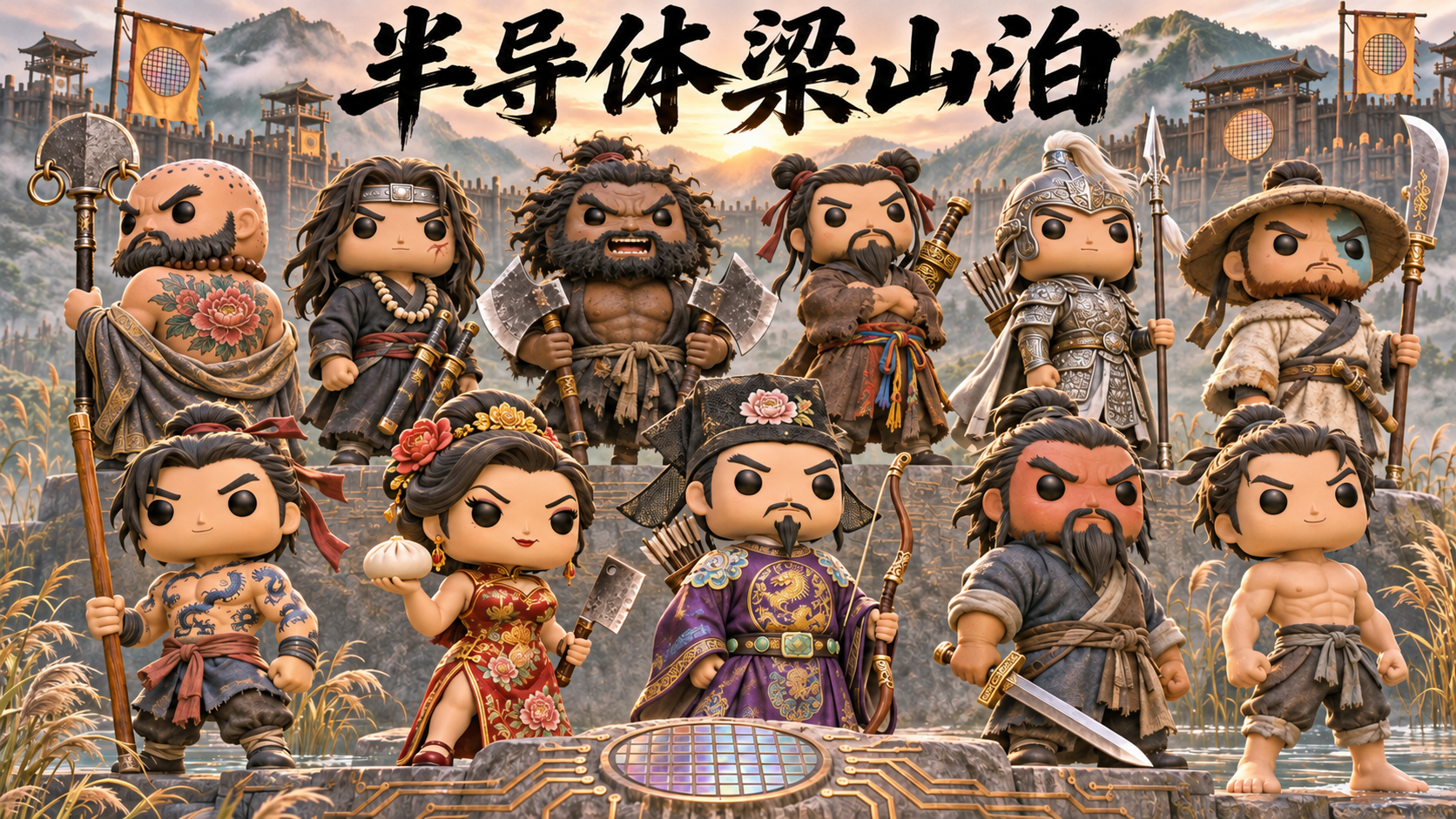
4 | Semiconductor Liangshan: different skills, different weapons
Liangshan works as a metaphor because its heroes do not all carry the same weapon. A GPU-only view misses much of the industrial structure.
| Layer | Publicly documented example | Next test |
|---|---|---|
| Wafer manufacturing | SMIC production and revenue | Yield, good-die cost, utilisation and maintenance |
| Memory | YMTC 3D NAND and Xtacking 4.0 | Do not confuse NAND progress with HBM independence |
| Process equipment | AMEC etch and film tools; NAURA etch, film and cleaning | Customer qualification and sustained production use |
| AI infrastructure | Huawei Ascend and Atlas SuperPoDs | Cluster availability, power and operating cost |
| Software | CANN, MindSpore and framework support | Migration effort, operator coverage and debugging |
| Models | DeepSeek releases and technical reports | Task-specific quality, licensing and operating conditions |
| Industrial deployment | Xiaomi manufacturing systems and industrial agents | Actual quality, downtime and unit-cost improvements |
Sources: SMIC, YMTC, AMEC, NAURA, Huawei, CANN, DeepSeek, Xiaomi.
Product claims are not independent benchmark results. Yet products, developer documentation, annual reports and offered services cannot be dismissed by invoking a stereotype.
Strength 1: move the contest from individual chips to systems
Huawei's September 2026 release says more than 1,000 Atlas 900 A3 SuperPoDs had been deployed and Atlas 950 was entering large-scale commercial use. These are company statements, not independently audited operating counts. Its Q1 2027 availability date for Ascend 960DT remains a plan. Huawei
Coordinating compute, memory, interconnect and software may offset some disadvantages at chip level. More hardware can also mean greater power demand, failures and communication overhead.
“N times Nvidia's performance” therefore requires matched precision, model, batching, response time and system power. Peak arithmetic throughput is not training time or profit margin.
Strength 2: change the cost of using the model
DeepSeek-V3 documents MoE, MLA, low-precision computation and overlapping communication with computation. Its reported training used 2.788 million H800 GPU-hours: an example of Chinese software innovation using foreign hardware. Technical report
Multiplying those hours by an assumed rental rate does not reveal company-wide R&D or total development expenditure including experimentation.
The official repository also describes Ascend inference support. Running inference is not proof that the same model was trained entirely on domestic hardware. Repository
Strength 3: AI has exits beyond a chat window
Xiaomi's 2025 annual report describes MOM for manufacturing operations, iDI for industrial data and iAgents for quality, equipment and logistics. This is company reporting, not an independent comparison of benefits. Printed page 125
The advantage is access to production settings: collect equipment data, return insights to inspection and maintenance, measure the outcome and improve again.
But factory automation is not synonymous with generative AI. Deterministic PLC control, servos, conventional machine vision and statistical maintenance remain central. Robot installations cannot serve as an autonomy leaderboard.
5 | Why “everything is domestic now” is also wrong
An NDRC-hosted expert discussion itself identifies shortcomings in high-end chips, foundational hardware and software, algorithms, compute allocation and talent. May 2026 commentary
Five distinctions remain essential:
- Prototype versus production: a successful demonstration is not years of reliable operation.
- NAND versus HBM: storage progress does not prove high-bandwidth-memory supply-chain independence.
- One process versus an entire fab: strong etching does not automatically supply lithography, metrology, materials and service.
- Model quality versus deployment ecosystem: benchmarks do not remove migration cost, capacity or operating constraints.
- National objectives versus shareholder returns: subsidies, duplicated investment, price competition and cash recovery still matter.
ASML explains how EUV can reduce complex DUV multipatterning, affecting process steps and yield. Annual report The decisive question is not just which nominal node can be demonstrated, but how many good devices can be delivered, at what cost, for how long.
6 | My objection to Professor Satoshi Kurihara's framing
At the lecture, I understood Professor Satoshi Kurihara of Keio University's Faculty of Science and Technology to express the view that China had not yet caught up. This is my account as an attendee. I intend to examine the wording, scope and context against the lecture record in a separate article.
A separate event article on this lecture is planned. It will compare the lecture record, public research and Chinese deployment examples, examining the context of the remarks and the research in greater detail.
My present challenge is specific: in the breadth of publicly available models, commercial computing infrastructure and factory deployment, China is far beyond the “AI we will begin working on” picture I took away from the lecture. Reassurance that China is simply behind does not explain those industrial realities.
Keio's official description already lists autonomous and general intelligence, swarm intelligence, emergence and complex networks; the lab also lists research presentations. Keio; Lab Calling it a laboratory that has not yet begun AI research would therefore conflict with its public record.
A country's industry and one laboratory differ in scale and purpose. Determining whether a Chinese team leads a particular cognitive architecture requires the same task and evaluation criteria. The breadth of deployment and the quality of a specific research contribution must be assessed separately.
Stanford HAI's 2026 AI Index describes a sharply narrowed US–China model-performance gap. AI Index This is not proof of Chinese supremacy in every field, but it strongly challenges a blanket description of Chinese AI as backward.
Where was the account of a working system?
What stayed with me was the emphasis on ethics and the possibility of losing control. I did not come away understanding what the lab's own AI had implemented, achieved or failed at under specified conditions.
My blunt reaction was: “I cannot see the implementation, yet we keep hearing fears of losing control. Is this foolish?” That is an attendee's judgement, not a verified finding that the laboratory has no implementation or results.
Ethics and safety work are necessary before deployment. That makes specificity more important: what hazard, what permissions, which measurements and what stopping mechanism? If future loss of control is the subject, show present capabilities and limits too. Otherwise an audience following industrial deployment cannot assess the scope of the research.
I am not asking for less vigilance. If the competitor matters, do not draw it smaller to feel safe.
7 | Japan's warning: customer, competitor and substitute
Investment inside China can create demand for foreign equipment, materials and components. Domestic customer qualification can simultaneously change who captures that demand. Neither “China grows, all Japanese suppliers win” nor “Japanese products are unnecessary” follows.
These are research questions, not trade recommendations or confirmed order changes from this report.
| Japanese research subject | What to track |
|---|---|
| Tokyo Electron and process-equipment peers | Process-specific adoption, local rivals, licences and service revenue—not just China revenue |
| Advantest and testing peers | Which specifications and test systems are selected as designs reach production? |
| Memory, materials and advanced packaging | Separate NAND, DRAM, HBM, bonding and substrates; track qualification and replacement time |
| FANUC, Yaskawa and automation peers | Local-supplier share, price, maintenance and integration costs alongside installation growth |
| Optical links, cooling and power | How cluster architecture changes quantities, specifications and suppliers |
Starting materials: TEL, Advantest, FANUC H1 2026 presentation, Yaskawa.
Chinese robot suppliers' lower domestic share in 2025 does not automatically show that Japanese suppliers gained the difference. Foreign-supplier mix, prices and product categories still require investigation.
The US must assess both the capability delayed by controls and the possibility that restrictions accelerate substitution. These procurement records alone establish neither that all controls are useless nor that sales can preserve dependence indefinitely.
Conclusion | “They have not caught up” needs measurements
China's advantage is not being first in every technology. It is the scale of an effort to connect different technologies, deploy them and improve them despite remaining weaknesses.
The warning concerns military applications, enforcement, industrial competition and outdated Japanese assumptions—not people's ethnicity. Unauthorised acquisition or violations should be judged by evidence; industrial research must not stop there.
Next evidence: explanations of H200 procurement, domestic equipment qualification, operating cost and availability of compute infrastructure, and measured factory-AI outcomes. The lecture critique belongs on that same comparable foundation.
Reassurance purchased by ignoring a competitor is not technological leadership. Count Liangshan's people—and its different weapons.